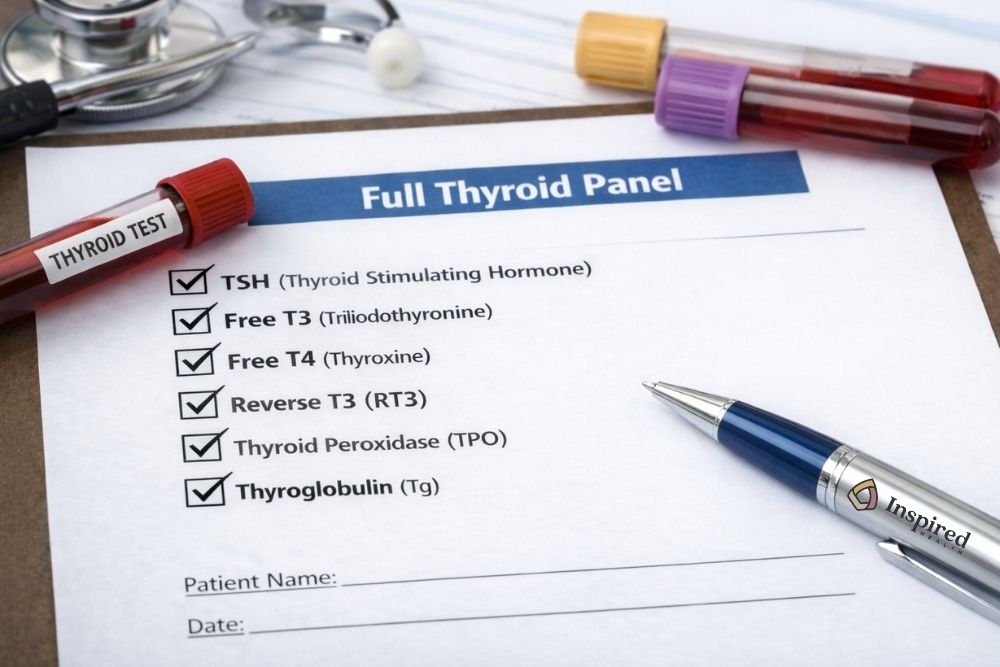
When we order labs to check our patients’ thyroid health (particularly for the first time), we order a comprehensive or “Full Thyroid Panel.” This is different than many conventional medical settings, where a provider might run a TSH, and maybe a Free T4. If the results fall within the standard reference range, patients are typically reassured that their thyroid is functioning normally.
But thyroid physiology is far more nuanced than one or two lab values can capture.
We take a broader Functional Medicine perspective at Inspired Health. Instead of asking only whether the thyroid is failing, we ask how well it is functioning within the context of the whole body. That means looking at hormone production, hormone conversion, immune involvement, and the factors that may interfere with how thyroid hormones work at the cellular level. A comprehensive or full thyroid panel gives us insight into patterns that a single marker (like TSH) simply cannot reveal.
A Full Thyroid panel consists of:
- TSH (Thyroid-Stimulating Hormone)
- Free T4 (Thyroxine)
- Free T3 (Triiodothyronine)
- Reverse T3 (RT3)
- Thyroid Antibodies (Thyroglobulin [Tg] and Thyroid Peroxidase, [TPO])
Understanding thyroid health requires looking beyond whether the numbers are “in range” and asking a deeper question: Is your thyroid functioning optimally for you?
Let’s discuss what a full thyroid panel reveals, and why it can change everything.
The Role of TSH: The Brain’s Signal
TSH, or thyroid-stimulating hormone, is produced by the pituitary gland in the brain. Its job is to signal the thyroid gland to produce hormones. When TSH rises, the brain is essentially telling the thyroid to work harder. When TSH lowers, it indicates the signal is being reduced.
TSH is an important regulatory marker. It tells us how the brain perceives thyroid hormone levels in circulation. However, it does not measure the amount of active hormone available to tissues, nor does it reflect how efficiently hormones are being converted or utilized.
It is a valuable starting point, but it is not a complete assessment of thyroid function.
Free T4: Hormone Production
The thyroid gland primarily produces T4 (thyroxine). This hormone functions largely as a precursor or storage form. Measuring Free T4 allows us to see how much unbound hormone is available in circulation.
Free T4 gives insight into production, meaning whether the thyroid gland is generating adequate hormone in response to TSH signaling. But T4 itself is not the most metabolically active form. It must undergo conversion to become T3.
If Free T4 is adequate but symptoms persist, the issue may lie not in production, but in conversion.
Free T3: The Active Hormone
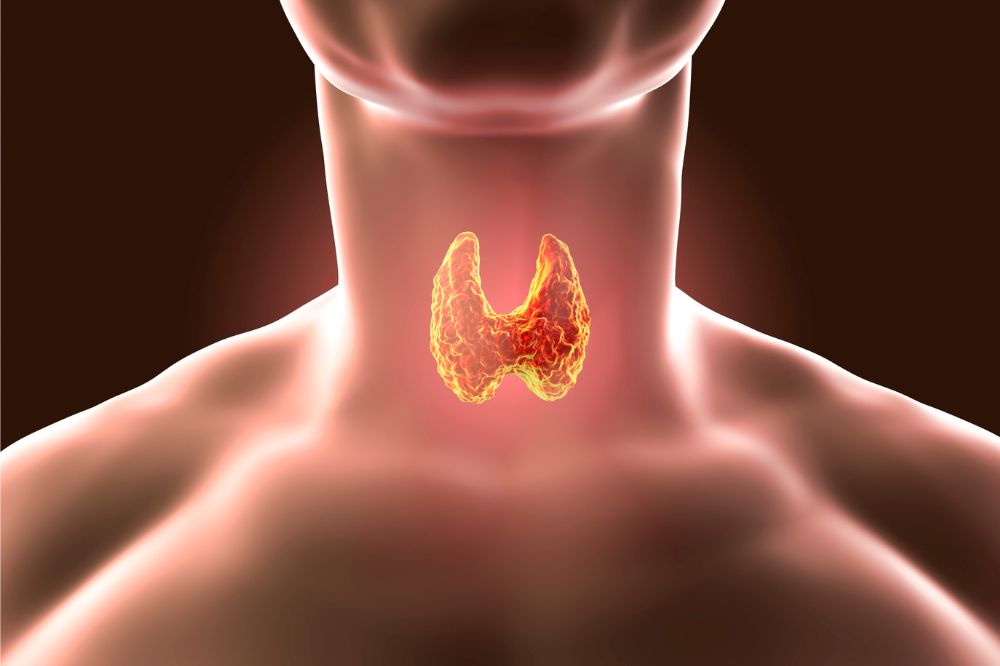
T3 (triiodothyronine) is the biologically active thyroid hormone. This is the form that enters cells and influences metabolism, mitochondrial energy production, temperature regulation, cognitive clarity, digestive motility, mood stability, and hair and skin health.
Measuring Free T3 tells us how much active hormone is available for cellular use.
Some individuals produce sufficient T4 but struggle to convert it efficiently into T3. This conversion process occurs primarily in the liver and other tissues and is influenced by stress hormones, inflammation, nutrient status (including iron and selenium), and overall metabolic health.
When Free T3 is suboptimal, even with a normal TSH, patients may experience symptoms consistent with low thyroid function.
Reverse T3: The Metabolic Brake
Reverse T3 adds another layer of understanding. Under conditions of physiological stress, such as chronic illness, inflammation, trauma, caloric restriction, or elevated cortisol, the body may convert T4 into reverse T3 instead of active T3.
Reverse T3 is biologically inactive. It can occupy receptor sites without activating them, functioning almost like a brake pedal on metabolism. This adaptive response is protective in acute stress but problematic when prolonged.
Elevated reverse T3 may help explain persistent fatigue, brain fog, or weight resistance in individuals whose TSH and Free T4 appear within normal limits. Without measuring it, this compensatory shift can easily go unnoticed.
Thyroid Antibodies: Identifying Autoimmune Activity
A significant percentage of thyroid disorders are autoimmune in nature. The two most common are Hashimoto’s thyroiditis and Graves’ disease.
Testing for Thyroid Peroxidase (TPO) Antibodies and Thyroglobulin Antibodies allows us to detect immune system activity directed against thyroid tissue. These antibodies can be elevated years before TSH shifts outside the standard range.
Without antibody testing, early autoimmune thyroid disease is often missed. By the time TSH becomes abnormal, significant immune-mediated damage may already have occurred.
Identifying antibodies early allows for a proactive approach focused on immune modulation, inflammation reduction, and root-cause investigation rather than waiting for overt dysfunction.
Why a Full Thyroid Panel Matters
When we look at TSH, Free T4, Free T3, Reverse T3, and Thyroid Antibodies together, we gain a more complete picture of where dysfunction may be occurring:
- Are signals from the brain appropriate?
- Is the thyroid producing adequate hormone?
- Is conversion happening efficiently?
- Is stress shifting metabolism into conservation mode?
- Is the immune system involved?
Each marker answers a different question. Together, they form a coherent physiological narrative.
The thyroid does not function in isolation. It is influenced by stress physiology, blood sugar regulation, gut health, liver function, nutrient status, and systemic inflammation. Evaluating TSH, Free T4, Free T3, Reverse T3, and Thyroid Antibodies provides deeper insight into production, conversion, immune activity, and metabolic signaling.
For patients who have been told they are “normal” yet continue to experience symptoms, expanding the lens often brings clarity.
ThyroSHINE (formerly Thyroid ReNew) features targeted nutrients and herbs that support healthy thyroid function. This unique formula supports the crucial conversion of Free T4 to the more active hormone Free T3.


Want more Inspired tips?
Be sure to follow us on Instagram, Facebook, and Pinterest.
Also, sign up for our newsletter!
Visit us in-person at Inspired Health, or schedule a TeleHealth appointment!
References:
Sheehan MT. Biochemical Testing of the Thyroid: TSH is the Best and, Oftentimes, Only Test Needed – A Review for Primary Care. Clin Med Res. 2016;14(2):83-92.
Vargas-Uricoechea H, Nogueira JP, Pinzón-Fernández MV, Schwarzstein D. The Usefulness of Thyroid Antibodies in the Diagnostic Approach to Autoimmune Thyroid Disease. Antibodies (Basel). 2023;12(3):48. Published 2023 Jul 22.
Welsh KJ, Soldin SJ. DIAGNOSIS OF ENDOCRINE DISEASE: How reliable are free thyroid and total T3 hormone assays?. Eur J Endocrinol. 2016;175(6):R255-R263.